Empowering AI Agents with MCP
11 Nov 2025- Definitions: Key MCP Terminology
- Problem Context: The AI Travel Agent’s Challenge
- Why MCP is Being Used: Bridging the Reality Gap for LLMs
- 💡 Example: Building a “Flight Booking” AI Agent with MCP
- 🔑 Key Summary
Definitions: Key MCP Terminology
First, let’s refresh our vocabulary for the components we’ll be discussing:
- Model Context Protocol (MCP): An open-source, standardized communication protocol that allows an AI Host (like an LLM application) to securely and reliably interact with external tools and services (MCP Servers).
- AI Agent: An autonomous AI system, typically powered by an LLM, that can reason, plan, and execute multi-step actions by interacting with its environment (using tools, APIs, etc.) to achieve a goal.
- MCP Host (The “Thinker”): The core AI application (e.g., the AI travel chatbot) that contains the LLM and orchestration logic. It decides what to do and when to use a tool.
- MCP Server (The “Do-er”): An external service that wraps a real-world tool (like a flight search API, a user database, or a payment processor). It exposes this tool’s capabilities to the Host via the MCP standard.
- MCP Client (The “Translator”): A component within the Host that manages the stateful, 1:1 communication session between the Host and a specific MCP Server.
Problem Context: The AI Travel Agent’s Challenge
Imagine you are building an “AI Travel Agent” chatbot. Your users want to have a natural conversation to book complex travel. A user might say:
“Book me the cheapest non-stop flight from New York to London, leaving next Tuesday. Use my saved passenger info and my business credit card.”
The core of your chatbot is a powerful LLM. However, this LLM, by itself, is “locked in a box.”
- It has no access to real-time data: It doesn’t know flight prices, availability, or schedules for next Tuesday.
- It cannot perform actions: It cannot actually execute a booking or process a payment.
- It cannot access private data: It doesn’t know the user’s “saved passenger info” or their “business credit card” number.
This presents the critical challenge: How do you securely connect your conversational LLM to real-time flight APIs, private user databases, and secure payment systems to complete a multi-step booking?
Why MCP is Being Used: Bridging the Reality Gap for LLMs
The Model Context Protocol (MCP) is the “plug-and-play” solution to this problem. It allows the LLM to become an active AI Agent by giving it a standardized and secure way to interact with the complex world of travel booking.
-
Standardized Tool Use: The travel industry has thousands of different APIs (one for each airline, plus aggregators like Amadeus, Sabre, Kayak, etc.). Instead of teaching the LLM how to talk to every single one, you create standardized MCP Servers.
- Analogy: The AI Host just knows how to ask for
flights.search(...). TheFlight Search Serveris the “travel agent” component that knows exactly which real API to call and how to parse its complicated response.
- Analogy: The AI Host just knows how to ask for
-
State Management & Context Awareness: A booking is a multi-step process: (1) Search, (2) Select, (3) Pay, (4) Confirm. MCP’s stateful client-server connection is perfect for this. The AI can “remember” the flight options it showed the user (from Step 1) and use the selected
flight_idto execute Step 3. -
Security and Sandboxing: This is the most critical benefit here. You never want your LLM to directly handle a user’s credit card number or passport details.
- Practicality: With MCP, the
Booking Servercan be a secure, PCI-compliant microservice. The AI Host can simply say, “Book this flight foruser_123using theirsaved_card_token.” The LLM never sees the sensitive data; it only orchestrates the secure transaction.
- Practicality: With MCP, the
-
Extensibility and Modularity: Once your AI agent can book flights, adding new capabilities is easy. You can simply add a
Hotel_Booking_Serveror aCar_Rental_Server. The AI Host’s core logic doesn’t need to change; it just learns it has new tools in its “toolbox.”
💡 Example: Building a “Flight Booking” AI Agent with MCP
Let’s illustrate with our user’s request: “Book me the cheapest non-stop flight from New York to London, leaving next Tuesday.”
Scenario:
A user types this prompt into an AI Travel Agent app.
MCP Components in Action:
- The MCP Host (AI Travel App):
- Contains the LLM and orchestration logic.
- Parses the user’s prompt and determines it needs a multi-step plan:
- Search for flights.
- Present options to the user.
- Get user’s selection.
- Get saved user/payment info.
- Book the flight.
- MCP Server (Flight Search Server):
- Wraps a real-world travel aggregator API (e.g., Amadeus or Skyscanner).
- Exposes tools like
search_flights(origin, destination, date, preferences).
- MCP Server (User Profile Server):
- Wraps the app’s internal user database.
- Exposes tools like
get_passenger_details(user_id)andget_payment_token(user_id).
- MCP Server (Booking Server):
- Wraps the airline’s secure booking and payment API.
- Exposes a tool like
execute_booking(flight_id, passenger_info, payment_token).
- MCP Clients: Components within the Host that manage the connections to these three different servers.
Step-by-Step Execution Flow:
This flow is more complex and shows the true power of MCP for orchestration.
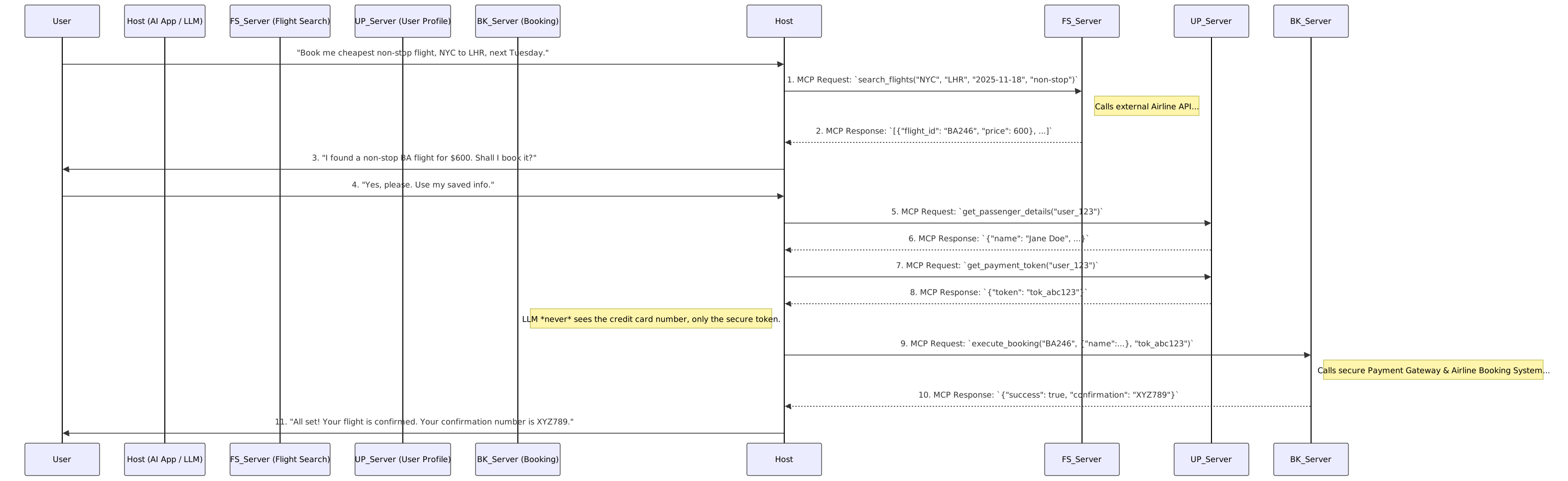
The above diagram illustrates the multi-step conversation between the user, the AI Host, and the various MCP Servers required to complete a flight booking.
🔑 Key Summary
This article explored the Model Context Protocol (MCP), a critical standard for building modern AI Agents.
- The Problem: Large Language Models (LLMs) are powerful conversationalists but are isolated from real-time data, private user info, and secure external systems. This prevents them from performing real-world transactions like booking a flight.
- The Solution (MCP): MCP provides a standardized, secure, and extensible “bridge” between the AI and these external systems. It defines a formal communication protocol for this interaction.
- Core Components: The architecture consists of the Host (the AI/LLM “brain”), Servers (which wrap real-world tools like flight APIs or payment systems), and Clients (which manage communication).
- Key Benefits (for Flight Booking):
- Abstraction: The AI Host just calls
flights.search, it doesn’t need to know the complex logic of the Amadeus API. - Security: The LLM never handles sensitive credit card or passport data. It only orchestrates the flow using secure tokens, while the specialized
Booking Serverhandles the secure transaction. - Statefulness: MCP manages the “session,” allowing the AI to remember the search results when the user is ready to book.
- Modularity: A
Hotel_Booking_Servercan be added later without re-engineering the entire system.
- Abstraction: The AI Host just calls
By using MCP, developers can transform LLMs from simple “chatbots” into powerful, transactional AI Agents that can securely and reliably complete complex tasks for a user.